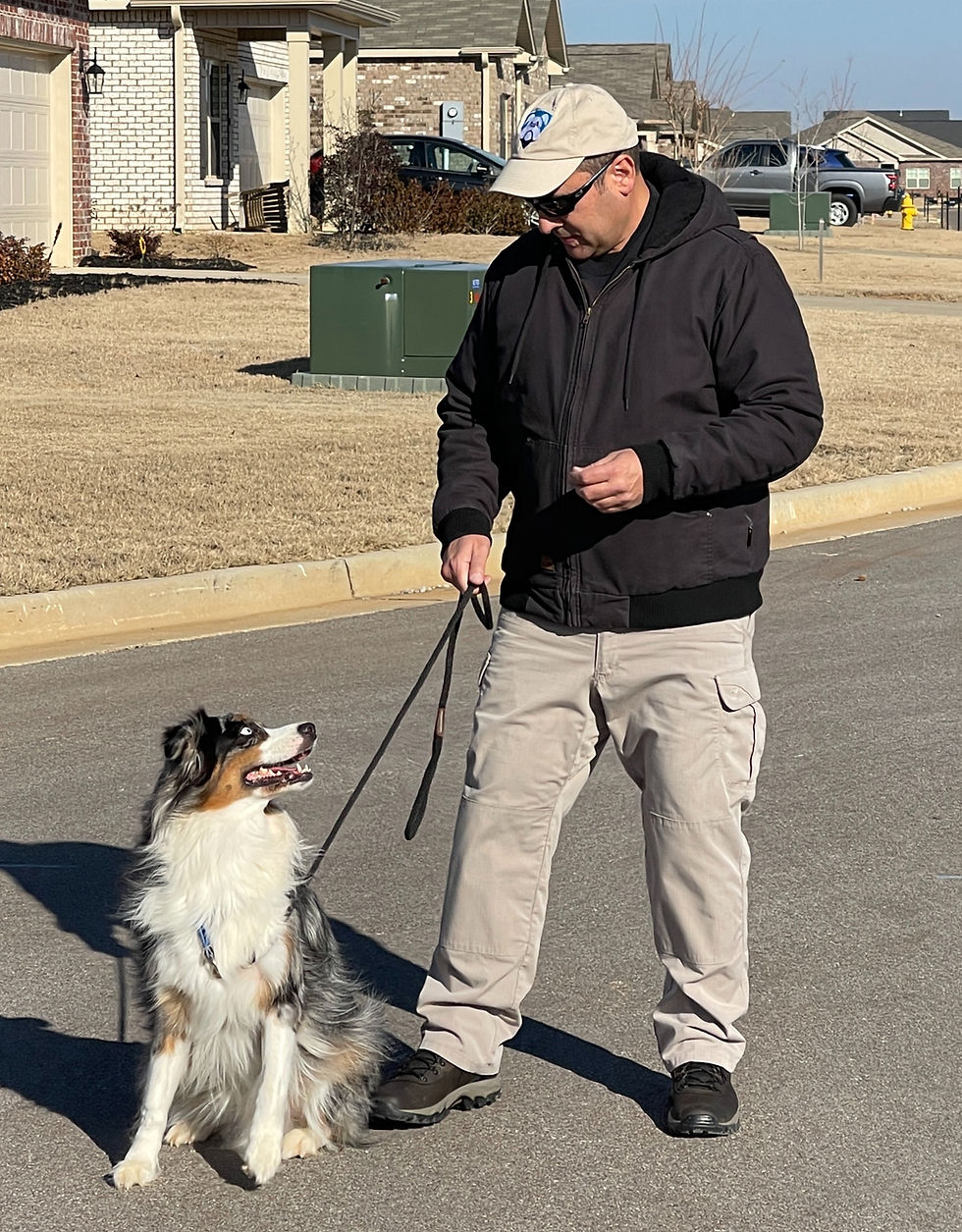
More Than Commands: What Dog Training Is Actually About

Dog training is not just about teaching commands; it's about helping owners understand their dogs and giving families tools that actually work in everyday life. This sums up about 90% of what I see in real life as a dog trainer. Most people don't come to dog trainers because their dog can't sit. They call us in desperation because life with their dog feels hard. People are desperate to get this fixed. Walks are stressful. Guests coming into the house are stressful. Even relaxing at home feels like work.
When your dog is stressing you out and frustrating you, it's time to take action. It’s time to start over with a coach, someone like me who can sit down with you, give you guidance and tools, and teach you how to work with your dog effectively without constantly barking orders at them or giving them commands.
When people call me, they usually have a long list, such as: stop barking, stop play biting, stop jumping, stop getting on furniture, stop running out the door, and stop pulling on the leash. The first thing I try to do is change their mindset, not to focus on everything they want fixed with the dog, but on what we want the dog to do instead.
If they don't want the puppy running to the door and jumping on people, they have to teach them to stay on their bed. If the dog is barking at them, they need to understand it's just communication and that the dog is trying to tell them something. If the dog is chewing on furniture, they're bored. If the dog is pottying in the house, they've got too much freedom. If the dog is pulling on the leash, it's not properly socialized. None of these things is the dog's problem. They're the owner's issues. They're the owners who aren't taking responsibility for doing what's needed to make the dog very polite, calm, and well-behaved from the very first day.
Commands vs Real Life
When the puppy doesn't behave, people start giving more commands and orders, but that doesn't work. That doesn't mean the dog is stubborn or bad. It usually means the training stopped at commands, and the owner thinks dog training is about giving and repeating commands. Never repeat commands, never get frustrated. Never let the puppy see you as being anything but a calm and confident leader. When you act this way, the dog doesn't trust you as a leader.
Dogs don't live in training sessions. The training sessions are the practice of living in chaos. Doorbells, kids, cars, bikes, squirrels, other dogs, cats, etc. Those are all distractions. And if training doesn't include working through the distractions, that falls apart in real life. In other words, if you're a football player, a quarterback, you practice for a good part of the year with your team, and that practice is setting you up for the games. The games are where it really counts…when you're in battle. If you're in a band, you practice with the band, then go on tour and play live. All of the rehearsals get you ready to play live when there's an audience and when it really counts, where you can't make a mistake.
Dog training is no different. You practice with a dog trainer, a coach, and you practice every day. You have to practice hundreds, or even a thousand, reps of one thing for the dog to really get it. I take the dogs I train, along with their owners, to dog-friendly stores with high levels of distraction. These include Home Depot, Lowe's, Tractor Supply, Rural King, Bass Pro Shops, Hobby Lobby, and Dick’s Sporting Goods. The other day, we took two rescue dogs who had never been outside the house, except for some short neighborhood walks, to Ace Hardware. That's also a very good place.
When we take these dogs to socialize them in these places, we work with them through distractions, and they have to exhibit calm behaviors like lying down and staying when people are walking in and out of the store. People on my Instagram page have seen these videos for years. A dog will start learning to behave well on its own. They'll lie down voluntarily. They'll watch people come and go from the store with their shopping carts and flatbeds. Behind them is a forklift, and announcements are coming from the loudspeaker. They just lie there and watch. And that is the best thing you can do for a dog, especially if they're reactive, stressed, or have anxiety. You don't have to walk around and greet people.
You don't have to do anything. Just have them lie there at the entrance and turn it off. That's the best way to get the dog to behave well in all situations.
Understanding the Dog
Most dog behavior issues make a lot more sense when we look at the dog's perspective for stress, excitement, fear, and confusion. Dogs communicate constantly, but most owners don't know what they're saying. When you understand why a dog is doing something, the solution becomes clear and usually simpler. You stop reacting emotionally, and you start responding intentionally. Reacting emotionally to your dog’s unwanted behavior when they don't know how to behave doesn't make any sense.
When the dog senses your frustration and stress, it will get more stressed out as well. Let me give you some examples. When your dog barks at you, they're communicating with you. They're trying to tell you something. The other day, I was working with a couple and a four-month-old Labradoodle. It kept barking at them during the training session, and I said, “Your dog needs to go outside and go potty.” They didn't see that. They went outside, and he went potty right away. They came back in, and no more barking.
Sometimes the dog barks because they're hungry. They're trying to tell us they need more food. We give them more food, and they calm down right away. It happens all the time, and it works every time.
If your dog is chewing on furniture, they're bored. If your dog can't sit still, they need more exercise. If your dog is getting ornery and not listening to you, maybe they need more sleep. Many dogs don't get enough sleep, especially puppies. Puppies need 16 to 18 hours of sleep a day.
The five things that the dog needs are:
Exercise
Mental stimulation
Enrichment
Socialization
Play.
At the very bottom is affection. Dogs don’t need to be picked up or held all the time. They don't need to have that much affection. They might get annoyed.
Play-biting is a serious problem stemming from excessive affection. They don't have any other way to communicate other than biting you with their sharp little teeth, because they don't have thumbs. They can't tell you anything because they don't know English. So the only way they can communicate with you when they don't want to be coddled all the time is with their mouths. Your dog is communicating with you all the time. You just have to listen.
Training the Owner Too
When I talk to a new client on the phone, I always let them know that most of the training is for them. The owners have to learn impeccable timing, be consistent, and have realistic expectations. Not because owners are doing anything wrong. Sometimes they are, and sometimes I have to correct that, but it's because they just never learned; nobody showed them. A lot of my clients are older, over 70, some even in their eighties, and they don't remember what it was like to own a new puppy. They get frustrated easily. They don't understand how much work it is to potty train a puppy. How much mental stimulation they need, and how much enrichment does that puppy need?
Owners need to show confidence with their dogs because, once they are confident, calm, and relaxed, they can provide good leadership. They set boundaries for the puppy, and then the behavior improves instantly. This is where the real progress happens. It has nothing to do with sit down, stay, come, leave it, drop it, or go to your bed. Has nothing to do with commands.
Tools That Work in Everyday Life
Real training gives families tools they can use when things go wrong. There are no perfect moments. There are only real moments. No dog is perfect. No human is perfect. Our cars aren't perfect. Our house isn't perfect. Our community isn't perfect. Our job isn’t perfect. The world is not perfect.
Some new puppy owners expect their dogs to be perfect after owning them for one week. They start being harsher and louder to them. They don't know how to interrupt the behavior without yelling. We never yell at a dog. We never punish a dog. You just need to set boundaries very clearly, early on. When I got Dixie, the first thing I taught her was to go to her bed, lie down, and stay. She was 10 weeks old. Now, at 6 years old, she is very well behaved. I rarely give her commands. She does it all on her own because of conditioning and because of this type of leadership.
Training takes a long time. You can’t do one session with the trainer, and suddenly it's going to be the magic bullet. I wish I had a magic wand to fix everything and a crystal ball to know how quickly a dog's going to change, but I don't have those things. No dog trainer has those in their arsenal. They don't exist.
The bottom line is this: if you're frustrated with your dog because you think they should know better and they still struggle to learn good behavior and understand what you want from them, it doesn't mean you're failing. It means you weren't given the right tools by a coach. This is where I coach people through this podcast, my books, and one-on-one training in Huntsville, Alabama. Dog training isn't about commands. It's about understanding communication and practical skills that work in real life, not by barking orders at your dog, yelling at them, and giving them command after command after command. That doesn't work because if it did, you wouldn't be calling a dog trainer or reading this article. You would have everything already figured out. You wouldn't need these resources.
Request a FREE Phone Consultation for dog training in Huntsville, AL.