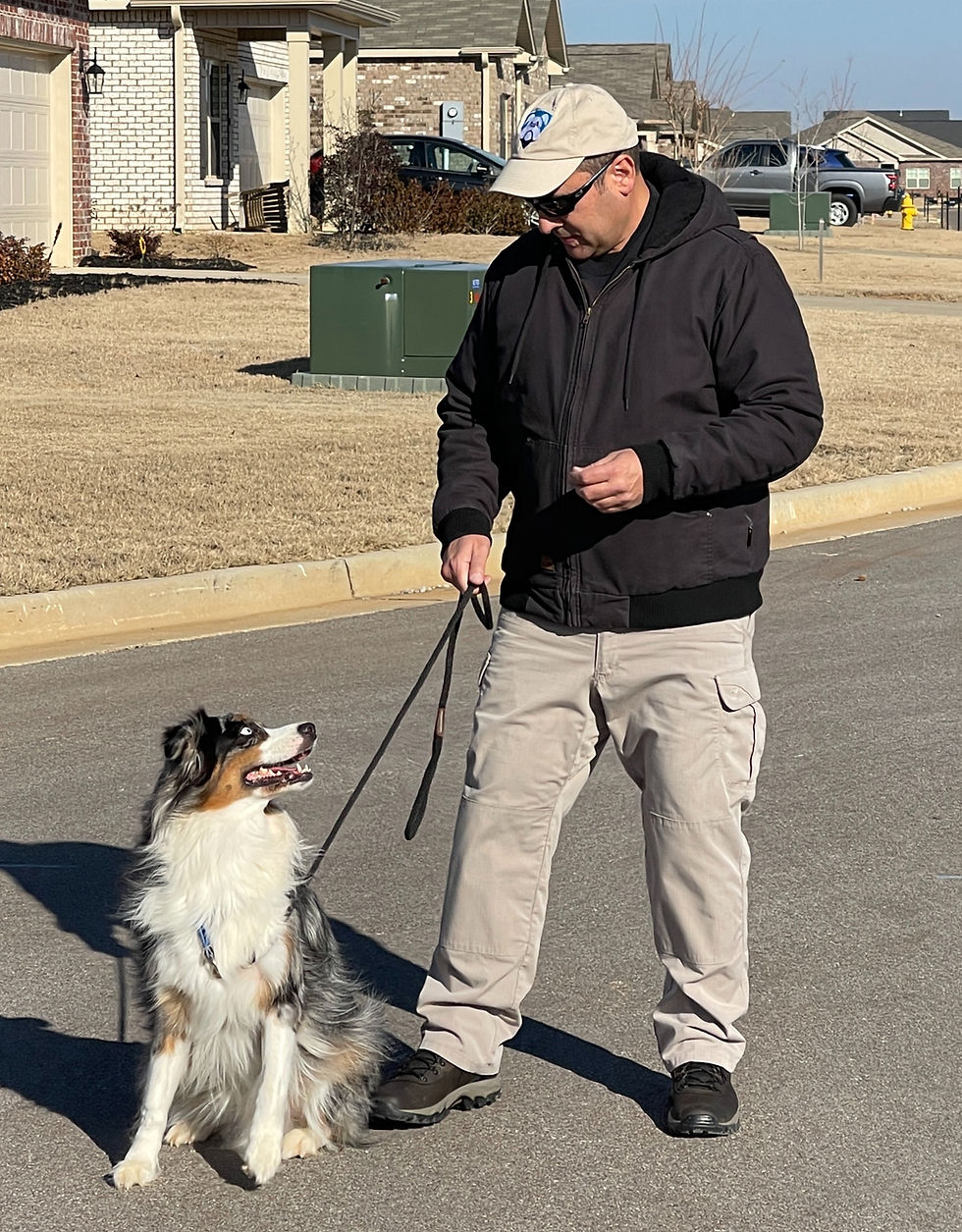
How to Improve Obedience Practice With Your Puppy

When I work with a new client, I structure the program to focus on the puppy's house manners first, their leash training second, and their socialization third. We will spend about three or four weeks working on the house manners, about two or three weeks on lease training, and then we take it on the road and go to Lowe's, Home Depot, Hobby Lobby, Tractor Supply, and any other pet-friendly stores that we can find for the puppy to get socialization practice.
Depending on the program length (8, 12, or 16 weeks), all additional sessions will include more socialization and field trips to the program. Maybe they're working on therapy dog training, or they're going to have the dog tested for the AKC Canine Good Citizen title. These clients will need more field trips for socialization. All that straining is done outside the house, in public places.
Oftentimes, owners come to me near the end of the program and say, “How do I get my dog to stay better at home when somebody knocks on the door?” My answer to that is always, "We worked on that a few months ago or a few weeks ago." They might come back with “Oh, well, how do I get my dog to stop barking at people when they walk by the house, or jumping on people when they come over?” And I explain to them that we already worked on that. We did all that stuff. And then the next question I ask them is, “Did you practice?” And they always admit they did not practice or they may have practiced once or twice, and that was it. Practice is something you have to do with your puppy on an ongoing basis.
Practice isn't something you can just do once and be done with it. I've done several episodes recently on the responsibility of raising a puppy. The main thing to remember is that once you take ownership of a puppy and they need obedience training, you have to practice with them. Follow the guidelines in this article to improve your practice sessions and the predictability of your puppy's learning of the obedient skills you want them to incorporate into their life. Because if you don't practice, you're not going to get anything out of it. Nothing's going to happen.
1) Daily practice is essential
Practicing once a week will not work. You have to practice consistently with your puppies starting at about seven or eight weeks old. They will learn over time, but you have to keep practicing and rewarding them, because puppies will do more of what they're rewarded for and less of what they're not rewarded for.
If you want them to stay on their bed, you literally have to practice hundreds of times or even a thousand repetitions. And if you think that's a lot, I had one client whose dog went to gun dog training in Tennessee, and they had to practice the “WO” command, where the dog can't move and has to stay still, 30,000 times. So if you think a few hundred times is a lot, it's not in this context.
2) Practice correctly the way that a professional dog trainer has taught you
If I go to somebody's house and I teach them how to teach that puppy to stay on its bed, and then they start using other methods, that's not going work because they're not following what I taught them to do. Teaching the puppy to stay is a three-step process, first with duration, and then working on distance, and then working with distractions. The same issues keep happening during the stay. The owner says, “I put the puppy in to stay, and I walked away, and he followed me.” That’s because they didn't follow the proper way to do it. First, work on duration: stand right next to your puppy, slowly creating distance over time, and then slowly add distractions. This takes months and months, and hundreds of repetitions, to get your puppy to stay, because no puppy wants to stay. They really don't.
3) Short training sessions are way better than long training sessions.
Keep the training sessions to 90 seconds to three minutes, and that's it. When I worked with Dixie at 12, 14, and 16 weeks old, learning her foundational skills, I did 90-second training sessions five times a day, and that's how she learned very quickly. I kept the training sessions very short so she would always win. She would never check out. When the puppy checks out, they lose, and you get frustrated. Then the puppy stops learning.
Remember, your job as the owner is to teach them what you want them to do, not what you want them to stop doing. It's very important to have that mindset. And I say that almost every podcast episode, teach them what you want them to do, not what you want them to stop doing. For example, if you have a puppy that's running to the door and jumping on people, it's not an issue of them jumping. It's an issue of them not staying on their bed. So practice them staying on their bed.
Look at professional athletes as an example of how much you should practice. Tiger Woods, Michael Jordan, and Tom Brady are good role models. If you study the history of these athletes, they practiced a lot. Tiger Woods practiced, did weight training, or did some type of workout in addition to his practice for 10 to 12 hours a day when he was not on tour. Michael Jordan would practice a thousand free throws at a time.
If you want your puppy to be an elite athlete, you have to practice with them. It's not optional. This is non-negotiable. You have to do the work. You have to put in the work. Don't blame it on the trainer that your puppy didn't learn how to stop pulling on the leash, or to stay on its bed, or to stop chewing the furniture. The trainer's already taught you that, and you didn't practice. Practice, and you'll have a great puppy.
Request a FREE Phone Consultation for dog training in Huntsville, AL.