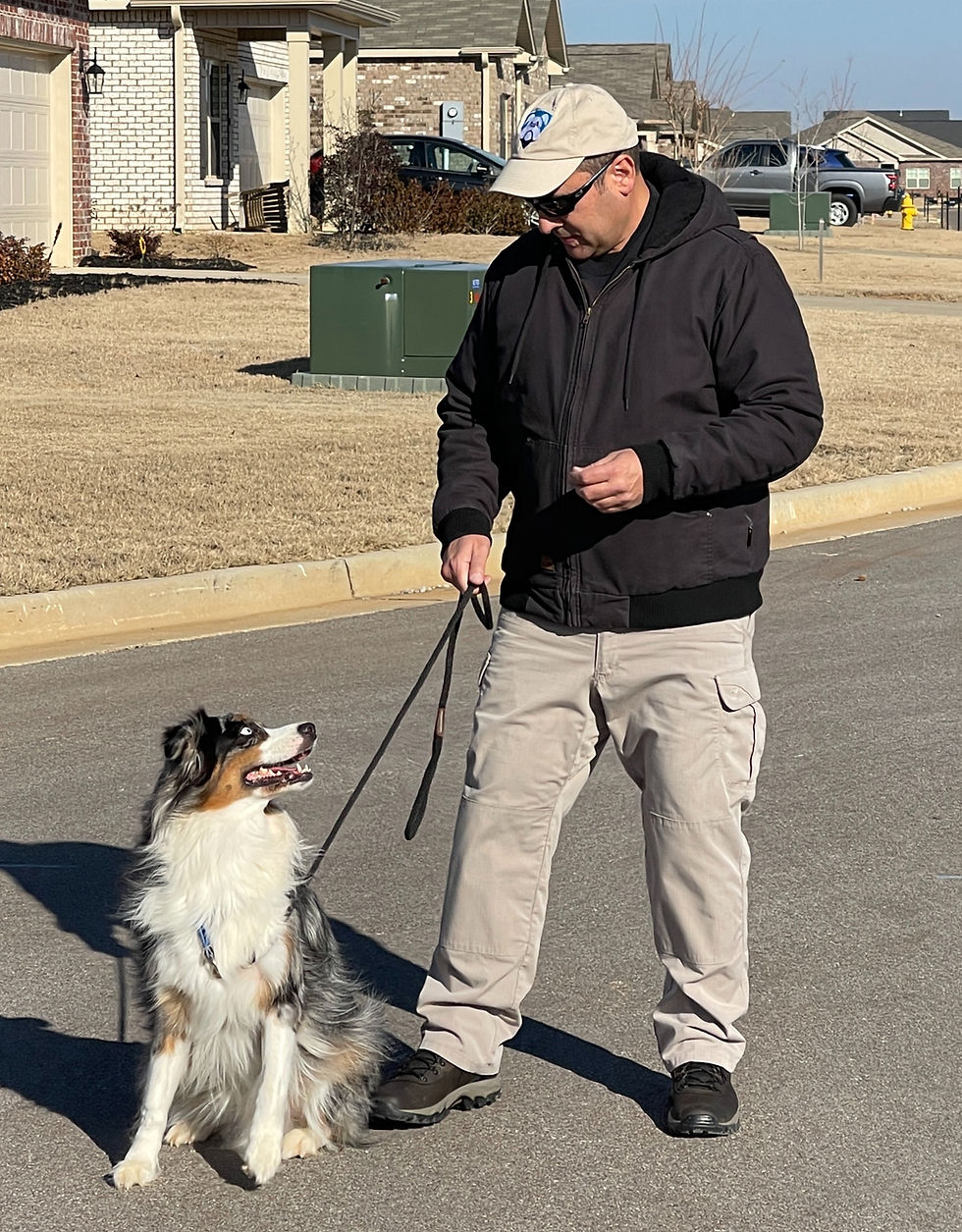
Does Your Puppy or Dog Trust You?
Updated: Mar 5

Being an effective leader and building trust in your dog requires a skillset grounded in effective communication, temperament, and focus. This is exactly what I'll discuss in this article.
What to do?
Make sure your communication with your dog is crystal clear.
In other words, I see a lot of new dog owners who will say a lot to their dog, and it means nothing. It's like a line in that Talking Heads song from the seventies, “You’re talking a lot, but you're not saying anything,” and this is how your dog feels. Sometimes you're talking a lot to them, but it doesn't register. Make sure your communication is crystal clear.
Trim the fat. What I mean is, instead of saying to your dog, “Dixie, sit down. Dixie, sit down.” You say, “sit.” And she sits, and you reward that so you don't have to say her name, and you don't have to say “sit down” because down is another command. Also, you don't want to say “lay down.” Just say down. That's it. You’re not saying much else that isn't needed. Tell the dog what you want and reward them for doing it.
Set your dog up for success.
With my dog training clients, I teach them to have fun with their dog through high-level mental stimulation and enrichment activities, which can include least training outside with some basic agility equipment, setting the dog up for success, and rewarding them to make sure they're happy. They're smiling, and they're having fun interacting with you. They're going to see you as a very effective leader for doing so, and they're going to trust you in the process.
Stay focused on teaching the dog what you want them to learn.
When I go to a lot of clients' homes, they always say, I want the dog to stop jumping, stop barking, stop chewing, stop running out the door, and stop pulling on the leash. I explain to them that we don’t focus on what we want them to stop doing. We want to focus on what we want to teach them and what we want them to do instead.
We want to avoid creating friction and conflict. If they are pulling on the leash, we teach them to be still, wait, and walk next to us on a loose leash. This is an alternative behavior, so they can't pull. We don't focus on the pulling. We focus on the alternative behavior and teach them something new. Because in reality, you can focus on what the dog isn't doing well all day long, and that's just going to frustrate you more. This is when dogs get rehomed. The owners have a laundry list of things the dog doesn't do well.
What not to do?
DO NOT talk to them so much. Especially with repeated commands, which encourage them to check out. Dogs don't use their ears as well as they use their eyes, and they don't use either one of those as well as they use their nose. If I want to get a dog to focus on me, I have to motivate them to do the work and focus on me, and nothing else. I do this with high-value food rewards and present it to their nose. Their nose will they say to their brain, “Oh, this guy's got some chicken breast. I love chicken breast. I'll do whatever he wants.” Then I've got the dog in the palm of my hands, and I haven't said a word to that dog.
When you talk to the dog too much, they're going to check out because they habituate to it. Your words become background noise.
DO NOT yell at your dog.
Yelling at a dog will create fear, anxiety, and stress in them. They will not trust you because effective leaders do not yell. They stay calm.
DO NOT show frustration and lack of leadership skills.
As I mentioned earlier, effective leaders don't yell. They don't get frustrated; they stay calm. They delegate authority appropriately and communicate effectively. Anybody who's ever managed or owned a business will understand this.
DO NOT use physical force with your dog.
It will never work long-term, and usually it doesn't work short-term. I hear stories of people grabbing their dog's snout or slapping it when it's not behaving well. This is absolutely inappropriate. This is borderline canine abuse, and this isn't good. Never use physical force. Those old days of rolling up a newspaper and slapping your dog are over. That was in the seventies. Don't do that.
DO NOT over-correct your dog.
Remember, I said earlier that the focus should not be on stopping a behavior, but teaching an alternative behavior. In other words, if the dog is jumping, I'm not going to say no, down, stop, or off. I teach a dog to sit politely for a pet instead of jumping when someone approaches, so they don't even have the chance to jump. They automatically know that when they greet somebody, they're going to sit or lie down and behave. They won't jump on people. That's a perfect way to focus on what you want the dog to do, rather than what you want the dog to stop doing.
If you're having problems with your dog and aren't sure whether they trust you, try this activity. Get out a piece of paper and write down things that you want the dog to learn and things that you want the dog to do better, and that's your focus. That's the training. They will respect you and trust you more for doing that.
In my book, The Complete Puppy Training Manual, there is a chart in the back with the section on Behavior Modification, and the chart has the behavior that you don't want, why they're doing it, what an alternative behavior is, and what you need to practice. It explains that it is essential to focus on the alternative behavior and on what you want the puppy or dog to do, rather than constantly focusing on what they're doing wrong.
If you don't think your dog trusts you, grab a handful of their food. Let them eat out of the palm of your hand. Give them treats frequently for sitting and being polite. Give them treats frequently for being a calm, good dog. This is called capturing. You don't even have to give them a command. When they do something good, say, good boy or good girl, and reward them for that . Do this, and they will trust you more.
When I work with fearful dogs that have no trust in anybody or anything, I use very high-value food rewards, chicken, turkey, steak, salmon, cheese, and hot dog. I build trust in that dog early on so that I can actually work with them and we can change their association with the fear triggers. That's the goal.
Request a free phone consultation for training your puppy or dog in the Huntsville, AL area.