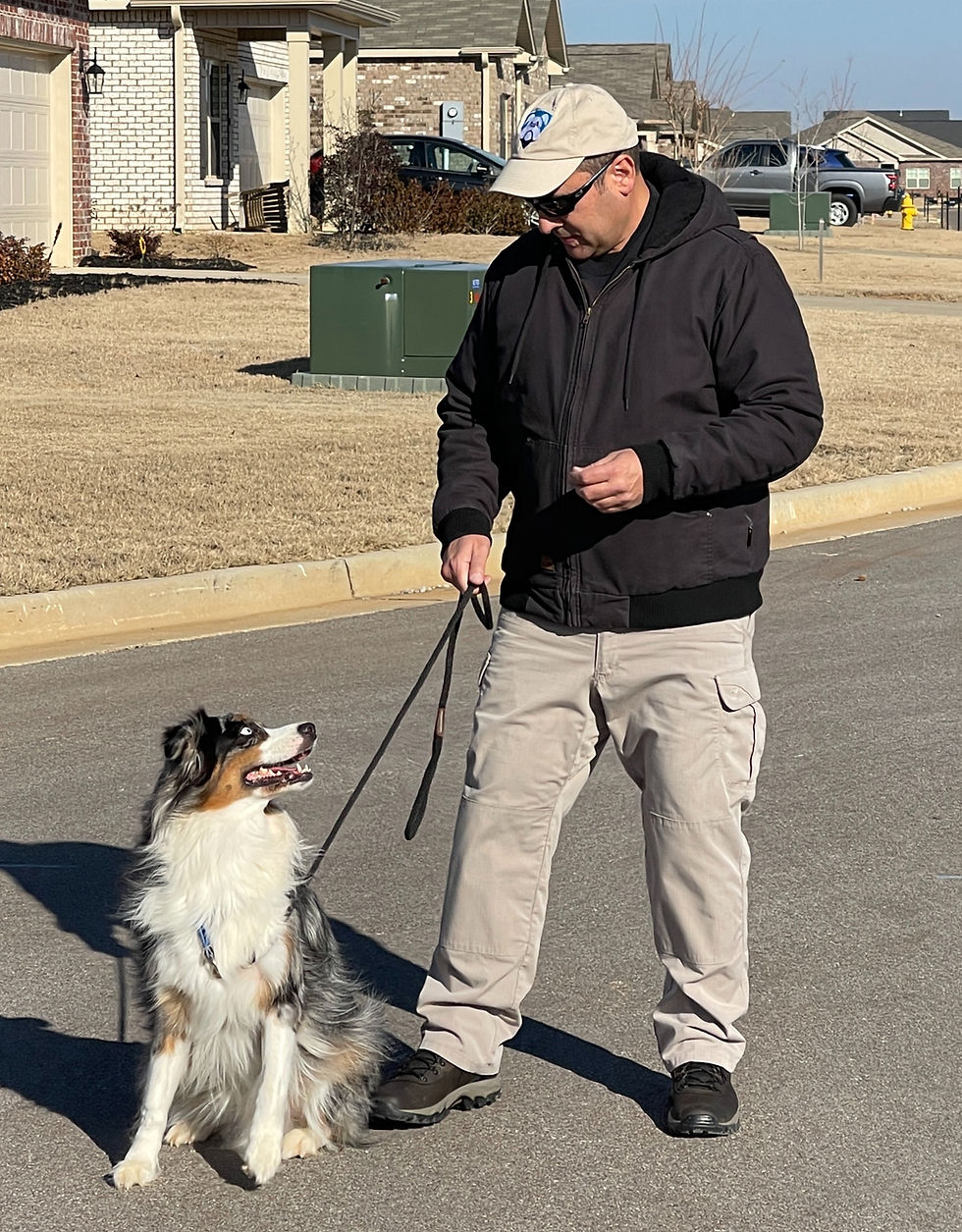
Why Punishment Should Not Be Part of a Puppy Program
Updated: Jul 30

Puppies are not miniature adults. They are babies, learning how the world works. Punishment often creates confusion, fear, and damage to trust, while teaching and reinforcing creates understanding and lasting behavior change.
Have you ever caught your puppy chewing on a shoe, having a potty accident on the floor, jumping on guests, or nipping at your hands and thought, “How do I punish this behavior?”
I get calls about this all the time, people asking me how to punish their puppy. If I can teach them how to punish their puppy when they do something wrong, I explain to them that's not what dog trainers do. I also have current clients who want to know how to punish their puppy for certain behaviors. And I tell them, that's unethical. We don't do that. We don't punish puppies.
Our job is to teach them. We want to teach the puppy what we want them to do. Just remember that puppies are learning every day. Puppy training should focus on education, not punishment. Think of it like this: You have a business and a new employee. On that employee's first day, they're making mistakes. You're not going to get mad at them and start shouting at them and tell them, no, no, no, stop, stop. You're doing it all wrong. You're going to pull them aside, train them, and then put them back on the job.
Focus on training, not punishing
Many owners bring home an eight-or nine-week-old puppy and expect perfect potty habits, no chewing, no play-biting, no jumping, no barking. Yet the puppy has only been on the planet for a few weeks. Puppies don't open their eyes until they're three weeks old. Then they start moving around, interacting with their littermates, getting corrected by the mother, and learning how to behave properly amongst other dogs. Hopefully, the breeder is handling them and getting them socialized with a variety of people, and they're starting to see and hear new things, their noses are working, and they're smelling a lot. People usually get a new puppy between 8 and 10 weeks old, sometimes 12 weeks. So the puppy hasn't been doing much in life yet. They're brand new to the world, literally.
Another key point to remember is that puppies aren't trying to be difficult. They're exploring, learning, making mistakes, and trying to make decisions. We don't punish toddlers for not knowing algebra. We teach them. Puppies deserve the same mindset. Be a teacher, be a leader for them, and teach them what you want.
Why punishment often fails
Problem #1: Punishment doesn't teach
With punishment, the puppy learns what not to do, but never learns what to do instead. Focus on teaching what you want the puppy to do, not what you want them to stop doing.
Here's an example. The puppy jumps on guests. The owners will yell and grab them; they'll push them off and say “off,” “down,” “no,” “stop.” The puppy may stop for a few seconds, but they'll go back to jumping on people again because they never learned how to greet people appropriately.
Problem #2: Punishing creates fear
When a puppy is afraid, they may begin to associate people with punishment, hands with punishment, and owners with unpredictability.
I see this a lot with rescue dogs. People try to pet the dog, and the dog runs behind the owner with the tail tucked because at some point, they were yelled at, or they had a hand raised above them, and they were threatened, so they have a fear of people who reach out to them or come and approach them. It's something that's really hard to change if it can be changed at all, because it's embedded into that puppy's mind.
Everything that the puppy learns from 4 to 12 weeks old is programmed into them. This is what their associations are. That's the critical period for what they learn. So creating fear in them at that age is probably going to be a lifelong process of them having fear whenever the trigger comes up. So you don't want to punish them at that age.
I barely even use corrections with young puppies. If I use a correction, it's a sound like “uh-uh.” It's a very gentle, mild correction. I don't think using the words “no,”“stop,” or anything harsh is going to teach them anything. So we don't use it. It's not part of a puppy training program.
Problem #3: Punishing damages trust
Remember that you're trying to build a relationship with your puppy. My job as the trainer is to teach the owners how to build a better relationship with the puppy. And trust is the foundation of the relationship and of all training. Puppies should see their owners as mentors, leaders, and guides, not as threats.
I went to a house today with an elderly gentleman who's really nice and really sweet to his puppy. The puppy loves him. It's a Great Pyrenees, which doesn't listen to him very well because he's very nice and gives it too much affection. But when I give the puppy a command, it does it 100% every time. It doesn't even question my authority at all. And I'm not yelling at it. I'm just telling it what I want. And every single time that I've given the puppy any direction, it follows me exactly.
Problem #4: The timing for punishment is difficult
Many punishments happen after the behavior. And the puppy often has no idea why the owner is upset.
I talked to someone on the phone who said their dog bit them when they tried to take a bone away. They said they sat the dog down afterward, and I said, "Bad dog,” and slapped it. I told them why it was a bad idea to handle it that way. First of all, it's after the fact. They don't associate the punishment with the resource guarding. Secondly, that's not going to teach the puppy anything. Luckily, there haven't been any more problems because we're working with the puppy on obedience training and preventing resource guarding now.
Common puppy behaviors that people punish
1: Potty accidents.
Why does punishment not work? The puppy simply doesn't make the connection yet. I heard people say we should rub the dog's nose in its urine after it makes a mistake in the house. No, you don't do that. That doesn't teach them anything. That doesn't help the situation.
A better approach is:
Better supervision,
Creating a puppy schedule,
Prevention by keeping them on a leash or in the crate using management,
Reward success when they go outside in the grass.
2: Puppy playbiting
Puppies explore with their mouths, so punishing them for doing so is not a good idea.
A better approach is:
Interrupt the behavior with an “uh-uh,” then redirect their mouth to something to chew on, such as toys, a bully stick, or something similar.
Stop overstimulating them. If the puppy's overstimulated, they're going to play with it. So end the over-stimulation by giving them a little time out, letting them settle down and calm down.
3: Chewing
Punishment doesn't work for chewing because chewing is a normal puppy behavior. They're going to chew.
A better approach is:
Don’t give them access to your shoes, clothes, furniture, or carpet.
Puppy-proof the environment and give them something more appropriate to chew on, such as a bully stick, nylobone for puppies, deer antler, or a collagen stick.
Reward appropriate choices. When they don't chew on furniture, you reward them and let them know they're doing the right thing.
4: Jumping
Punishment doesn't work for jumping because jumping gets attention. Puppies are going to do more of what they're getting attention for. If the puppy's jumping and you're pushing the puppy down and saying “down,” which means to lie down, then the puppy's going to jump more because it's a fun game.
Another thing about saying “down” when the puppy jumps is that when I'm teaching the puppy to lie down after the sit, the puppy starts jumping. Somewhere along the way, the owner had taught the puppy that “down” means to jump. You can't talk or touch them while they're jumping. You've got to interrupt it with this sound, “uh-uh,” and then redirect it to something else and reward that behavior.
For jumping, we teach four paws on the floor and reward calm greetings.
When they greet people, and they're standing, sitting, or lying down, they get praise and a reward. There's value in not jumping.
What to do instead of punishment
Teach desired behaviors. Instead of focusing on mistakes, focus on teaching success. Ask this question before you get upset at your puppy. “What do I want my puppy to do? What do I want them to learn? How can I help them learn? How can I help them succeed?”
Instead of jumping, they sit for greetings.
Instead of play biting, they grab a toy.
Instead of chewing furniture, you give them something else to chew on.
Reward good behaviors.
I often go to clients' homes and find out that they've never praised their puppy. They've never told their puppy they're doing a good job. They never reward the puppy when the puppy makes good, voluntary decisions.
Start noticing when they're making good decisions and tell them, " Good boy, good girl, good dog.”
The decisions that they make that are good could be:
Calm behavior
Good choices: They lie down on their own, and they stop bothering you.
Quiet moments when they are very calm, not barking or running around the house trying to get into trouble.
Chewing on their toys, bully sticks, and other things instead of the furniture.
When they're doing those things, you just look at the puppy and say, "That's a good dog. Good job,” and then they'll know that they're doing something well. Instead of punishing them with corrections and harshness, let them know when they're doing something good.
Your job as the owner is to set the puppy up for success. That's it. You're teaching them things that will help them succeed.
A big part of that is management. You want to make sure that you use baby gates, crates, and a leash in the house. I always recommend people keep the puppy on a slip lead in the house. The only thing they could do is start chewing the slip lead if they don't have something else to chew on. It's not a big deal. You get a cheap leash, and you put it on them in the house, and that's all you have to do. Never let the puppy out of your sight. If you can't watch them, they'll get into trouble until they're adults. You want to prevent mistakes whenever possible with great management.
The long-term benefits of not punishing your puppy
We're teaching instead of punishing. This creates trust in you with the puppy.
They enjoy learning,
They recover from mistakes quickly,
They feel confident,
They understand expectations.
Training isn't about controlling, directing, or barking orders at a puppy all the time. It's about helping them succeed and learn how to make good decisions on their own without you having to tell them every second. The goal isn't to catch your puppy doing something wrong. The goal is to catch your puppy doing something right and reward them for doing it.
Most people focus only on the puppy's negatives and never on the positives. When you’re raising a puppy, you have to be very positive.
I've got Dixie at 10 weeks old (she’s 6 years old now), and I used these techniques when I raised her. I have tons of videos that I show my clients when I work with them. And they say, “How did you get that dog to do that on the first day, on the second day?” I said, “I use the methods that I'm teaching you right now.”
In Review
Puppies are learning, not misbehaving on purpose.
Punishment often creates confusion and fear.
Teaching creates understanding.
Reward the behaviors you want more of, not the ones you don't.
Focus on guidance rather than correction.
I want you to do something with your puppy this week. Look for three good choices your puppy makes each day and reward them. Either give them a treat or give them praise. You may be surprised how quickly those good choices start happening more often.
Request a FREE Phone Consultation for dog training in Huntsville, AL.