Keep The Puppy Training Simple

A lot of new puppy owners want to teach their puppy all these extravagant obedience commands and training too soon, which can create problems for the puppy down the road. It also creates problems with the puppy learning the foundational skills effectively.
Why It's Best To Keep It Simple
You don't want to overwhelm the puppy too early. You wouldn't want to try to get a 10-year-old kid into college. They are in elementary school, and then they need to go through junior high school, high school, and then college. They need to learn the skills to do all of the things to get them ready for life, and that's what we do with puppies.
Think of puppy training as elementary school. Keep it that simple with arithmetic, reading, history, and science. You're not going to do anything over the top for a young kid, so why would you do anything over the top for a young puppy?
When I work with a new client, I focus on the foundational skills of the seven basic obedience commands.
Sit
Down
Stay
Come
Leave it
Drop it
Bed (or place).
Every adult dog that I see with a serious behavior problem has never learned these foundational skills, and that's part of the issue. The owners bypassed the dog's learning of these skills, and the dogs later have problems with chewing, barking, jumping, and socialization. Most of them can’t cope with going to Home Depot or Lowe's, something simple where they should be able to do it.
The Consequences of Making The Training Too Complex
I see a lot of people teaching their puppy tricks such as shake, roll over, and play dead. By doing this, the owners neglect the foundational stuff of sit, down, stay, and come. The things we actually want puppies to do at an early age, rather than jumping on guests when they come over. We want them to walk nicely on a leash in public so we can take them places. A well-trained and well-behaved dog can do that even at four or five months old.
The Three Areas of Puppy Training Focus
When people hire me to train their puppy, there are generally three areas of focus where problems arise.
House Manners
Leash Manners
Socialization Skills.
House Manners
We focus on the house manners first to prevent a dog from going to the front door and jumping on guests as they come in. We work on them staying on their bed to prevent a dog from having potty accidents in the house. We have them stay on their bed so we can watch them and know where they are, and they need to go out. We teach the puppy to stay on its bed to prevent them from chewing your furniture and barking at everything outside the front windows.
A dog that can stay on its bed in the house is a well-behaved dog. A dog that runs around and does anything at once in the house, has no structure and no manners, and is always getting itself into trouble. There are exceptions to this, of course, but we're talking mainly about puppies under six months old.
Leash Manners
Generally, when it comes to leash training, I'm often called in to help with leash reactivity. These are dogs that have been pulling on a leash for a long time. They react to other dogs and people. They get overstimulated and excited. The triggers pose challenges for them in coping with everyday life outside the house. On a leash, there's a barrier to frustration. The barrier is the leash. The leash is holding them back from getting to the other dog or person. Dogs can also be leash reactive to cars, bikes, airplanes, birds, and other animals. It can be reactive to anything on a leash.
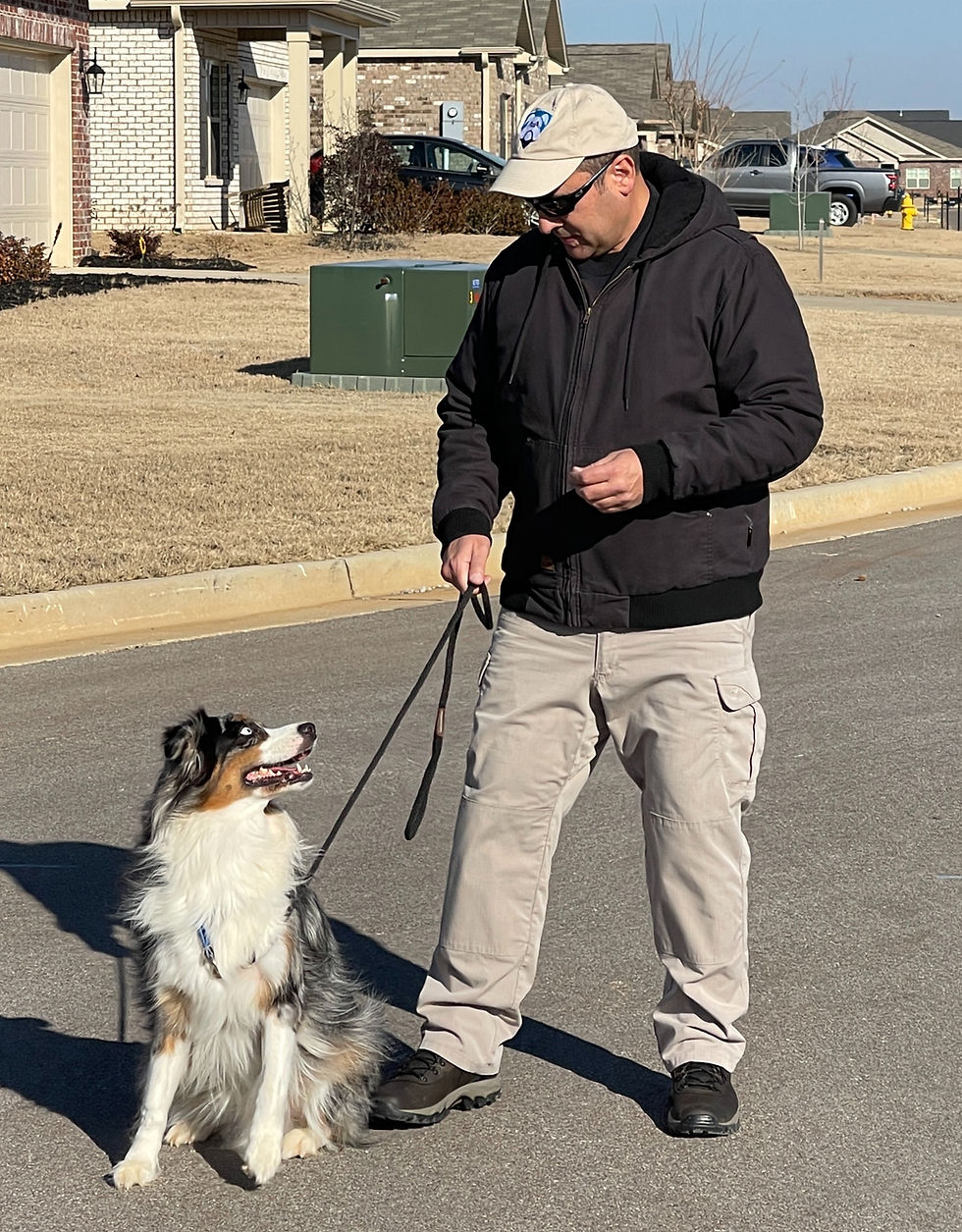
We want to prevent that early on by giving the dog the foundational skills through leash training, not necessarily taking long walks with the puppy and letting them misbehave, but teaching them proper obedience skills while on a leash. This is what I do with all the puppies that I train.
Socialization Skills
We take puppies on field trips to places where they'll learn to behave and be civil in the presence of a lot of distractions. We go to Home Depot and Lowe's, where there are forklifts, pallet jacks, flatbeds, and shopping carts. There are announcements, music, a lot of people, and usually other dogs.
We like to go to Hobby Lobby and outdoor malls such as Bridge Street, where you can go in and out of a variety of stores. We can be outside or inside in a split second. This is really fun, and it's exciting for dogs. They get to see a lot of different people and locations with varied floor textures, aisle sizes, and vibes. Some have clothes, home goods, or jewelry. They get to experience all of these things in one dog-friendly shopping mall.
It is very important for puppies to learn socialization skills because the majority of older dogs that have never been socialized can't just suddenly do it. If a dog is afraid, anxious, or stressed, they just can't suddenly learn how to be a very social dog at eight years old. It's virtually impossible for a dog that age to suddenly adapt to social situations.
The critical period for socialization is usually between 4 and 12 weeks old. Some people say between 8 and 16 weeks old. Regardless, by 4-5 months, the puppy needs a lot of socialization and has already gone on many car rides to many different places.
What about vaccines? At three months old, your puppy is not going to places where there is contamination from animal feces, such as the dog park or a daycare. Usually, they're going to places with a controlled environment where the risk of contracting a disease is very low.
Basic, Intermediate, and Advanced Puppy Training
What I just described is what a basic training program looks like with our puppies. If we want to reach the intermediate level, I encourage everyone to look into the AKC Canine Good Citizen program. This adds more sessions to the basic program with more training and testing for the AKC CGC. This program ensures that your dog can be anywhere in public, at the vet, or at the groomer. Being pet by people while walking well on a leash and not being affected by a higher level os distractions.
Our advanced program adds another level of AKC certification: the Advanced Canine Good Citizen. This has 10 more items that the dog has to train and test on, which raise the level of socialization skills. For example, you are sitting at a counter or table filling out a form, and your dog is lying underneath you and out of the way. You walk through a door to go into a store with a cup of coffee, and you hold the door open, the dog goes through, and doesn't pull you through, and the coffee doesn't spill.
How to Tell if Your Puppy is Overwhelmed
The number one way that you know it's happening is when they check out. They don't like training anymore. It's a chore for them. It's no longer fun. This is when it's too much. You need to back off a little bit. Take it easy, take it slower. Focus on sit, down, stay, and come. Practice those 25 times a day for months until your puppies are really good at them with a vocal command and a hand signal, and then you can add more later. You've got plenty of time to add more to the dog's training program. You don't have to do it all right away.
Request a FREE Phone Consultation for dog training in Huntsville, AL.